The Martham Voters of the Nineteenth Century
A great deal of information about the social history of the village and also its increasing prosperity during the years of the nineteenth century is revealed in the lists of the people of Martham who were able to vote at Parliamentary Elections in that century.
Following the extension of the franchise during the century, the numbers of voters steadily increased and political parties came into existence. Discovering how the franchise was extended and how that affected people in Martham being entitled to vote, is a very interesting study.
At the beginning of the century, it is immediately apparent that 'social status' was of great importance and how much it mattered. Generally, 'gentlemen' who had enough money to keep them so that they did not have to work with their hands, were at the top of the social stratum. Below them were yeomen (who were freeholders of about 100 acres of land) below them were husbandmen (who held their land copyhold of the manor), below them were the tradesmen and professional men (who were very valued members of the community as their skills and expertise were essential for the welfare and prosperity of society) and below them the unskilled agricultural labourers who rented their cramped and squalid homes, were desperately poor and lived a hand to mouth existence.
In reality, it was not as straightforward as that, as I discovered when I looked at the details of those on the list of voters who applied for land at the time of the Inclosure Act of 1805. From that document I discovered that yeomen also held copyhold land, husbandmen also held freehold land and the tradesmen and professional people held their properties freehold and/or copyhold.
To be a voter early in the century, was an indication that you were an educated person, able to manage your financial affairs and run a profitable business. You were a person of prestige. You were also acquainted with the 'right sort of people'.
At the beginning of the century only a very few of the parishioners had the right to vote at Parliamentary elections. The system had not changed since the fifteenth century. In order to be on the list of voters, you had to prove by producing evidence, that you paid tax on property worth (if you leased it to someone else) at least 40/- per annum (£2 per year) or that you were a leaseholder or tradesmen who had a valuable business. Having proved that, your name would appear on the Poll Book list and you would be able to vote for a parliamentary candidate. At that time there no political parties as such. You voted for an individual because you had been persuaded that he was a worthy candidate to be a member of parliament.
There was no secret ballot.
How aware people were of the issues of the day is difficult to know, although newspapers may have been available in Martham. Education in Martham was open to only handful of boys who attended the Free School.
The Poll BooksThe earliest list of voters I found for the nineteenth century was in the Poll Book of 1802. A copy is shown in Appendix one. The list that year was very detailed and showed 26 names. Nine of them were yeoman farmers, seven of them were husbandman farmers, five of them owned land in Martham but did not live in the village, however most surprisingly nine names were of people who were obviously very successful tradesmen including one labourer. The meaning of the word 'labourer' has altered over time.
The labourer is also on the next Poll List of 1806, a copy of which is shown in Appendix two. By that time he had become a husbandman. The number of voters had increased to 31. On that list there were eleven yeomen, six husbandmen, twelve tradesmen, one surgeon and one gentleman. Three voters did not live in Martham.
Comparing this list with that of the those who had made claims for land under the Inclosure Act of 1805 it was interesting to discover that 26 had made claims. This also revealed the astonishing complexity of land holdings in those days. Although 90 people made claims, many of them held small amounts of land and would not have been educated enough to keep records and accounts, so would not have been able to apply to be voters.
The next list of voters I was able to find was of 1817. There were 27 names, some of whom did not appear on the previous list. A few names from the previous were not there. Few other details were given.
By 1832 there were 52 names, four of whom were non-resident. New names appear and some previous names have disappeared, but otherwise there are few details
1832 was the year of the well-known Reform Act which considerably altered the requirements for voting rights and reorganised many constituency boundaries thus putting an end to 'Rotten Boroughs'. The franchise was extended to men (the first time men are specifically mentioned) who were tenants of property worth £50 or more. Also, Electoral Registers were to be revised annually.
The Electoral RegistersThe next list of voters I studied was the Electoral Register of 1834. From that year onwards each Electoral Register states:- the full name of the voter, his place of abode, his nature of qualification (whether the property is freehold, copyhold or he is a £50 occupier) and the location of his property. A copy of the list is in Appendix three.
The 1834 Electoral Register shows the following as '£50 Occupation' ;-
- William Cooper with property by the Green. He was a surgeon
- George Edward Francis with property at West End Farm. His father who was a 'gentlemen' owned the land and he must have been either the manager or a tenant farmer.
- Richard Forder was Master at the Free School.
- Robins Purdy was a 'gentleman' with property at Grove Farm.
- John Pollard had property, but not at Martham
The 1841 Electoral Register shows the following additional '£50 Occupation' ;-
- Silvanus Hillersden was a farmer with property at Moregrove. He was later a 'gentlemen'.
- George Palmer was a farmer with property at Hall Farm. He was probably a tenant of Thomas Grove who was Lord of the Manor.
- Robert Long was a farmer with property at Cess.
The 1844 Electoral Register shows just two '£50 occupiers' :-
- Sylvanus Hellersden with property at Moregrove
- George Palmer had property at Hall Farm.
The 1849 Electoral Register shows two more '£50 occupiers':-
- Hymphrey Dyball was a farmer with property near the Mills.
- James Cooper Faulke was a miller with property at Market Road. [The corn mills].
This seems to be an indication that tenant farming has become a profitable business.
From 1836 trade directories are also being published and many of the names appear in both. With this information it is possible to discover more about the voters and their personal circumstances and to follow their fortunes through the ensuing years.
The Tithe Commutation Act came into effect in 1842 converting all the Tithe contributions into a money payment called a Rentcharge. From that document we have a record of who owned all the land in Martham and who actually occupied each plot of land. Comparing this document with the Electoral Registers of close dates, it is possible to discover even more precise details about each voter.
The 1867 Reform Act extended the franchise to land holdings worth £5 and men over 21 who had occupied a separate dwelling (with no regard to value), as owner or tenant for 12 months or lodgings of £10 unfurnished value, were able to vote. The Martham Electoral Register of 1868/9 shows a small increase in the number on the list however interestingly there are 10 men listed as '£12 Rated Occupiers'.
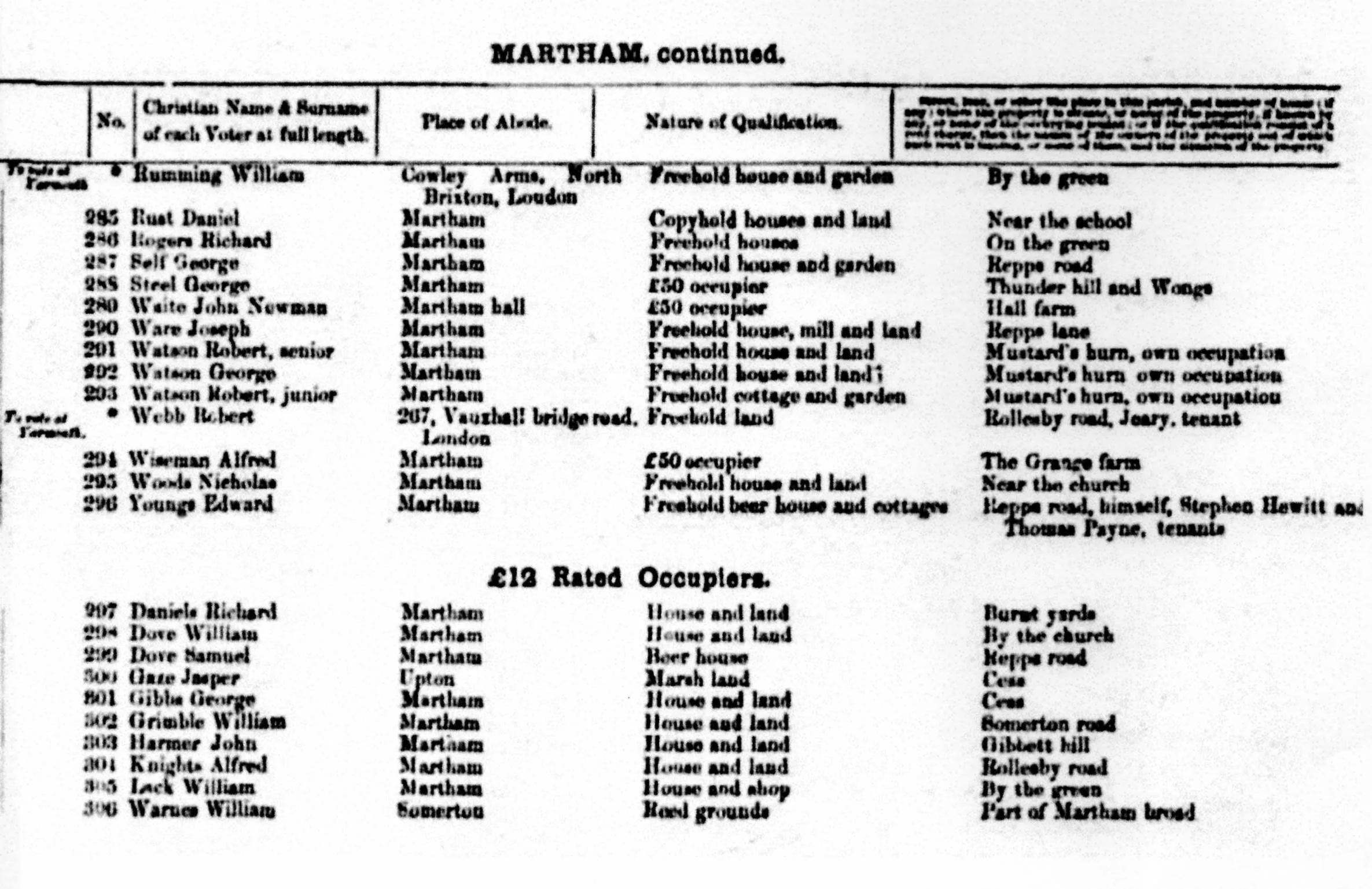
- Richard Daniels was a farmer of Burnt Yards
- William Dove was a butcher – near the church
- Samuel Dove had a beer house in Repps Road [the Star Inn]
- Jasper Gaze lived at Upton but owned land at Cess
- George Gibbs was a farmer at Cess
- William Grimble was a shopkeeper in Somerton Road
- John Harmer was a market gardener at Gibbet Hill
- Alfred Knights was a farmer and dealer of Rollesby Road
- William Lack was a grocer by the Green
- William Warnes lived at Somerton and had reed grounds in part of Martham Broad
(Samuel Dove was renting one of the beer houses built by Steward and Patterson Brewers of Norwich. He had been advertising in the trade directories since at least 1850.)
The layout of this register is perhaps significant. The list of £12 occupiers looks like a separate addition of second class voters. This style was to continue throughout the century.
There may have more men eligible to vote but who had not applied to be on the list. This could have been because they were not sufficiently literate and filling in a form was something that they could not do. The availability of schooling in Martham has increased slightly by this time as the Vicar's School had opened in 1852. Previous to that there was just the Free School which educated only a very few boys.
The next reform was the Ballot Act of 1872 which introduced the secret ballot.
By 1881 the number on the Electoral Register of Martham had increased to 102. Of these only three were £50 occupiers and 25 were £12 occupiers, indicating that the number of small businesses was increasing. In 1979 the railway from Great Yarmouth had reached Martham, bringing tourists to the village, thus increasing business opportunities. The number of freehold and copyhold voters was also increasing. That can only mean that these holdings were being divided as the amount of land available could not increase.
The 1884 Reform Act further extended the franchise by reducing the property qualification, affecting especially rural areas and making them equal to boroughs. For Martham the Electoral Register of 1887 shows a huge increase in the number of voters to 250. Of these 65 were owners (freehold and copyhold) and 185 were occupiers.
By this time more people were literate as the Board School had been open since 1873.
The 1888 Act of Parliament established County Councils with elected councillors. The Electoral Register of 1892 that I studied, gives the names of those entitled to vote in Parliamentary elections and County Council elections and then complications are revealed. There are three divisions of electors. Division one listed those who could vote at both Parliament and County Council elections. Division two had the name of a man who could only vote at a Parliamentary election and division three listed those who could only voted at a County Council election. Division three included the names of women voters.
The Parliamentary Local Government Act of 1894 created another tier of local government with Rural Distrait Councils being created in rural areas resulting here in Flegg Rural District Council coming into existence.
The 1894 Act also created Civil Parishes, separated from the ecclesiastical parishes, to take over some of their responsibilities. Thus Martham Parish Council came into existence in 1896 elected by local people – men and women.
The 1898 Electoral Register was the next one I was able to find and that reveals further divisions in the electorate. Division one listed 193 electors who could vote at Parliamentary, County Council and Parish Council elections. Division two listed 18 people who were entitled to vote for Parliamentary and Parochial candidates but NOT for County Councillors. Division three listed 61 people who were able to vote at County Council and Parochial Council elections but NOT at Parliamentary elections. This division included numerous women voters who were occupiers of property and also had husbands who voted. Further research is needed to explain the necessity for these complications.
At the beginning of the century about 2% of the population of about 1000 were able to vote at parliamentary elections, however by the end of the century it was about 12%. The population had increased steadily through the century to 1177 at the 1891 census. The number of voters increased again as reforms in the next century extended the franchise to many more people.
Appendix OnePoll Book, 1802 — West Flegg Hundred: Freeholders Names, where the Freeholds lie, and Residence — Martham
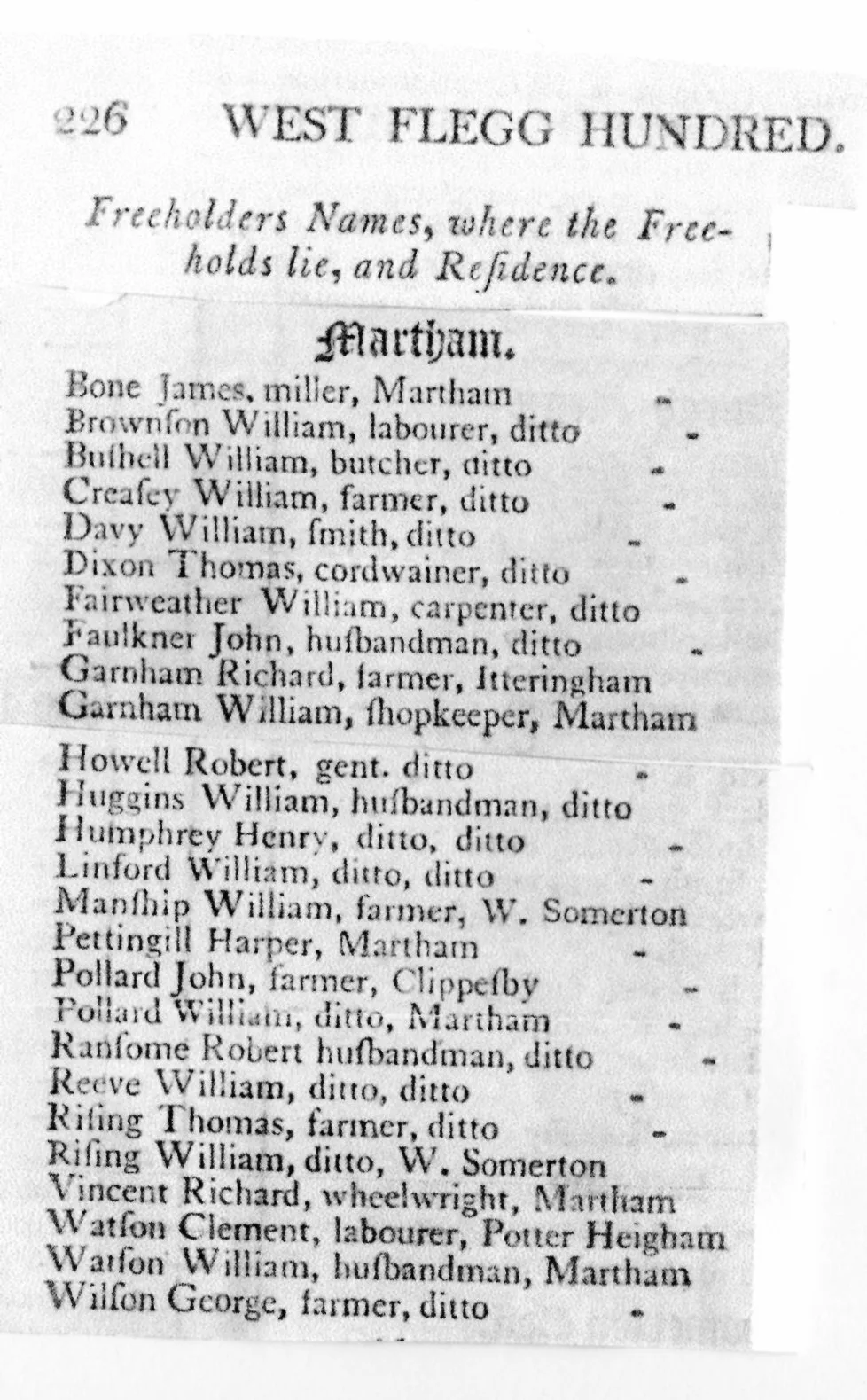
Transcription of the original printed list (the old long “ſ” has been modernised to “s”):
- Bone James, miller, Martham
- Brownson William, labourer, ditto
- Bushell William, butcher, ditto
- Creasey William, farmer, ditto
- Davy William, smith, ditto
- Dixon Thomas, cordwainer, ditto
- Fairweather William, carpenter, ditto
- Faulkner John, husbandman, ditto
- Garnham Richard, farmer, Itteringham
- Garnham William, shopkeeper, Martham
- Howell Robert, gent., ditto
- Huggins William, husbandman, ditto
- Humphrey Henry, ditto, ditto
- Linford William, ditto, ditto
- Manship William, farmer, W. Somerton
- Pettingill Harper, Martham
- Pollard John, farmer, Clippesby
- Pollard William, ditto, Martham
- Ransome Robert, husbandman, ditto
- Reeve William, ditto, ditto
- Rising Thomas, farmer, ditto
- Rising William, ditto, W. Somerton
- Vincent Richard, wheelwright, Martham
- Watson Clement, labourer, Potter Heigham
- Watson William, husbandman, Martham
- Wilson George, farmer, ditto
Poll Book, 1806 — Martham
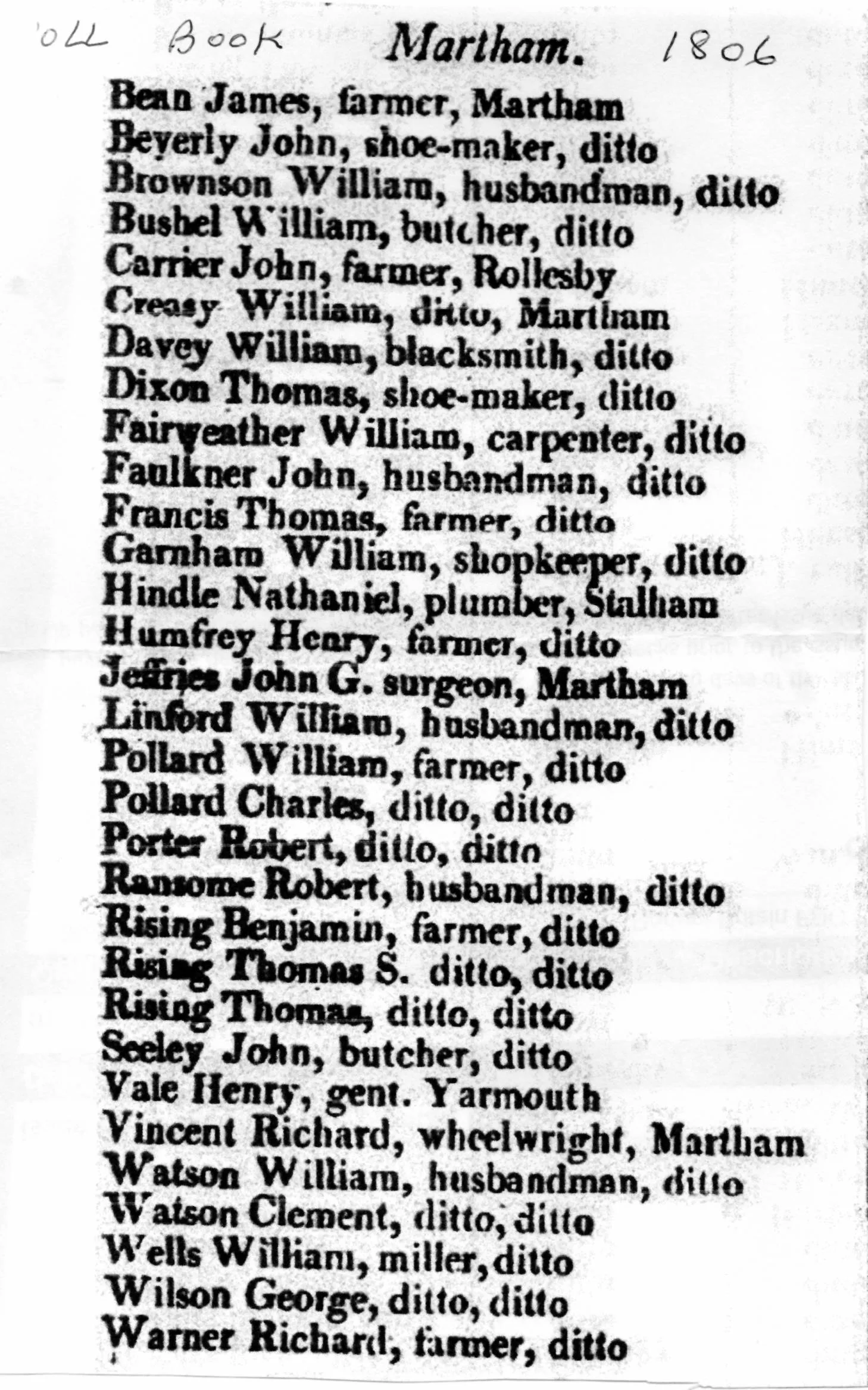
Transcription of the original printed list:
- Bean James, farmer, Martham
- Beyerly John, shoe-maker, ditto
- Brownson William, husbandman, ditto
- Bushel William, butcher, ditto
- Carrier John, farmer, Rollesby
- Creasy William, ditto, Martham
- Davey William, blacksmith, ditto
- Dixon Thomas, shoe-maker, ditto
- Fairweather William, carpenter, ditto
- Faulkner John, husbandman, ditto
- Francis Thomas, farmer, ditto
- Garnham William, shopkeeper, ditto
- Hindle Nathaniel, plumber, Stalham
- Humfrey Henry, farmer, ditto
- Jeffries John G., surgeon, Martham
- Linford William, husbandman, ditto
- Pollard William, farmer, ditto
- Pollard Charles, ditto, ditto
- Porter Robert, ditto, ditto
- Ransome Robert, husbandman, ditto
- Rising Benjamin, farmer, ditto
- Rising Thomas S., ditto, ditto
- Rising Thomas, ditto, ditto
- Seeley John, butcher, ditto
- Vale Henry, gent., Yarmouth
- Vincent Richard, wheelwright, Martham
- Watson William, husbandman, ditto
- Watson Clement, ditto, ditto
- Wells William, miller, ditto
- Wilson George, ditto, ditto
- Warner Richard, farmer, ditto
Electoral Register, 1834 — Hundred of West Flegg: Martham
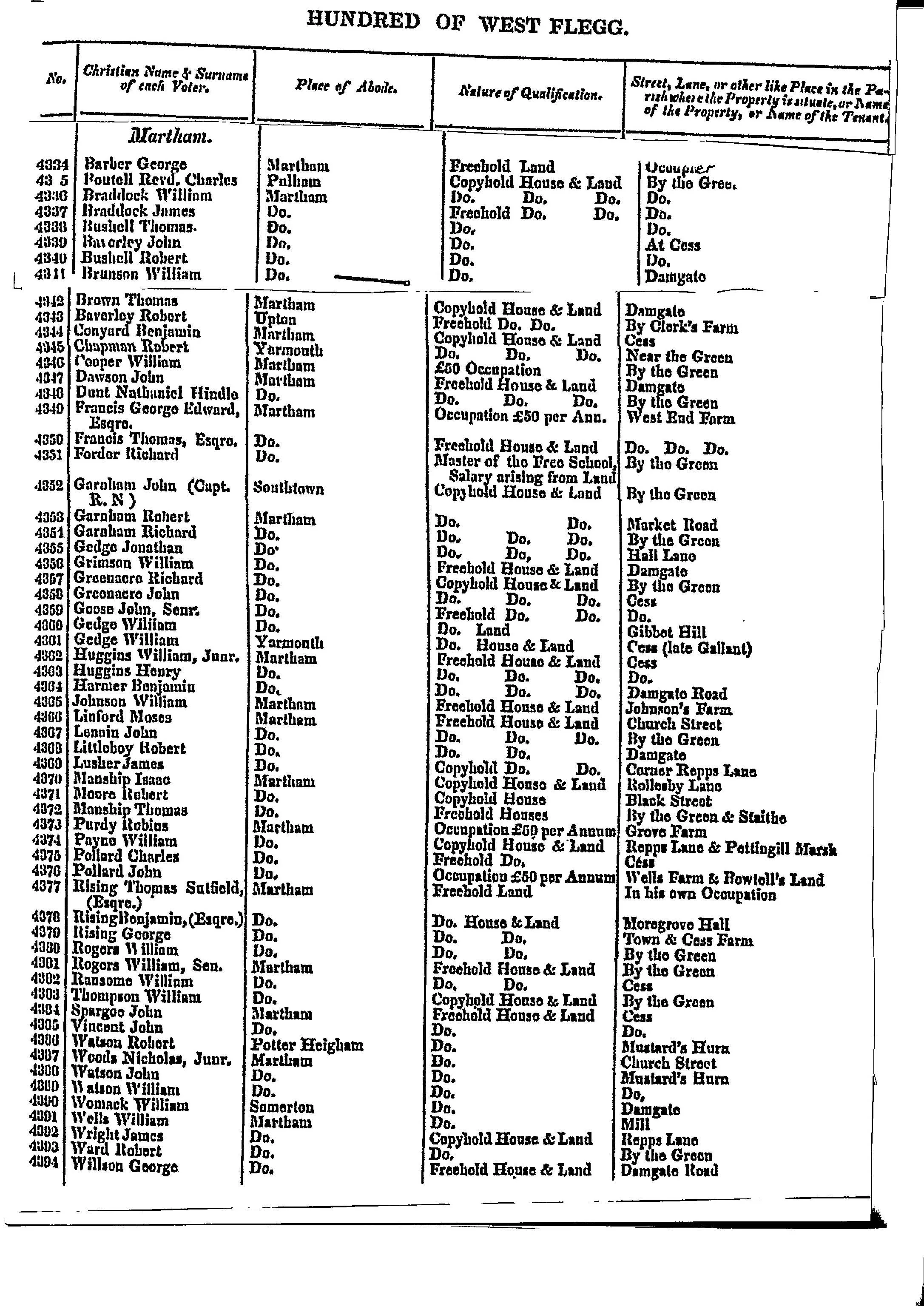
Transcription of the original register table. Repeated entries printed as “Do.” (ditto) have been written out in full; the original spellings have been retained.
| No. | Christian Name & Surname | Place of Abode | Nature of Qualification | Street, Lane or Place where the Property is situate |
|---|---|---|---|---|
| 4334 | Barber George | Martham | Freehold Land | Occupier |
| 4335 | Pottell Revd. Charles | Pulham | Copyhold House & Land | By the Green |
| 4336 | Braddock William | Martham | Copyhold House & Land | By the Green |
| 4337 | Braddock James | Martham | Freehold House & Land | By the Green |
| 4338 | Bushell Thomas | Martham | Copyhold House & Land | By the Green |
| 4339 | Beverley John | Martham | Copyhold House & Land | At Cess |
| 4340 | Bushell Robert | Martham | Copyhold House & Land | At Cess |
| 4341 | Brunson William | Martham | Copyhold House & Land | Damgate |
| 4342 | Brown Thomas | Martham | Copyhold House & Land | Damgate |
| 4343 | Beverley Robert | Upton | Freehold House & Land | By Clerk's Farm |
| 4344 | Conyard Benjamin | Martham | Copyhold House & Land | Cess |
| 4345 | Chapman Robert | Yarmouth | Copyhold House & Land | Near the Green |
| 4346 | Cooper William | Martham | £50 Occupation | By the Green |
| 4347 | Dawson John | Martham | Freehold House & Land | Damgate |
| 4348 | Dunt Nathaniel Hindle | Martham | Freehold House & Land | By the Green |
| 4349 | Francis George Edward, Esqre. | Martham | Occupation £50 per Ann. | West End Farm |
| 4350 | Francis Thomas, Esqre. | Martham | Freehold House & Land | West End Farm |
| 4351 | Forder Richard | Martham | Master of the Free School, Salary arising from Land | By the Green |
| 4352 | Garnham John (Captn. R.N.) | Southtown | Copyhold House & Land | By the Green |
| 4353 | Garnham Robert | Martham | Copyhold House & Land | Market Road |
| 4354 | Garnham Richard | Martham | Copyhold House & Land | By the Green |
| 4355 | Gedge Jonathan | Martham | Copyhold House & Land | Hall Lane |
| 4356 | Grimson William | Martham | Freehold House & Land | Damgate |
| 4357 | Greenacre Richard | Martham | Copyhold House & Land | By the Green |
| 4358 | Greenacre John | Martham | Copyhold House & Land | Cess |
| 4359 | Goose John, Senr. | Martham | Freehold House & Land | Cess |
| 4360 | Gedge William | Martham | Freehold Land | Gibbet Hill |
| 4361 | Gedge William | Yarmouth | Freehold House & Land | Cess (late Gallant) |
| 4362 | Huggins William, Junr. | Martham | Freehold House & Land | Cess |
| 4363 | Huggins Henry | Martham | Freehold House & Land | Cess |
| 4364 | Harmer Benjamin | Martham | Freehold House & Land | Damgate Road |
| 4365 | Johnson William | Martham | Freehold House & Land | Johnson's Farm |
| 4366 | Linford Moses | Martham | Freehold House & Land | Church Street |
| 4367 | Lennin John | Martham | Freehold House & Land | By the Green |
| 4368 | Littleboy Robert | Martham | Freehold House & Land | Damgate |
| 4369 | Lusher James | Martham | Copyhold House & Land | Corner Repps Lane |
| 4370 | Manship Isaac | Martham | Copyhold House & Land | Rollesby Lane |
| 4371 | Moore Robert | Martham | Copyhold House | Black Street |
| 4372 | Manship Thomas | Martham | Freehold Houses | By the Green & Staithe |
| 4373 | Purdy Robins | Martham | Occupation £50 per Annum | Grove Farm |
| 4374 | Payne William | Martham | Copyhold House & Land | Repps Lane & Pettingill Marsh |
| 4375 | Pollard Charles | Martham | Freehold House & Land | Cess |
| 4376 | Pollard John | Martham | Occupation £50 per Annum | Wells Farm & Powell's Land |
| 4377 | Rising Thomas Sutfield, Esqre. | Martham | Freehold Land | In his own Occupation |
| 4378 | Rising Benjamin, Esqre. | Martham | Freehold House & Land | Moregrove Hall |
| 4379 | Rising George | Martham | Freehold House & Land | Town & Cess Farm |
| 4380 | Rogers William | Martham | Freehold House & Land | By the Green |
| 4381 | Rogers William, Sen. | Martham | Freehold House & Land | By the Green |
| 4382 | Ransome William | Martham | Freehold House & Land | Cess |
| 4383 | Thompson William | Martham | Copyhold House & Land | By the Green |
| 4384 | Spargo John | Martham | Freehold House & Land | Cess |
| 4385 | Vincent John | Martham | Freehold House & Land | Cess |
| 4386 | Watson Robert | Potter Heigham | Freehold House & Land | Mustard's Hurn |
| 4387 | Woods Nicholas, Junr. | Martham | Freehold House & Land | Church Street |
| 4388 | Watson John | Martham | Freehold House & Land | Mustard's Hurn |
| 4389 | Watson William | Martham | Freehold House & Land | Mustard's Hurn |
| 4390 | Womack William | Somerton | Freehold House & Land | Damgate |
| 4391 | Wells William | Martham | Freehold House & Land | Mill |
| 4392 | Wright James | Martham | Copyhold House & Land | Repps Lane |
| 4393 | Ward Robert | Martham | Copyhold House & Land | By the Green |
| 4394 | Willson George | Martham | Freehold House & Land | Damgate Road |
Electoral Register, 1868/9 — Martham, continued
Transcription of the original register table:
| No. | Christian Name & Surname of each Voter at full length | Place of Abode | Nature of Qualification | Street, Lane or Place where the Property is situate |
|---|---|---|---|---|
| 284 | Running William | Cowley Arms, North Brixton, London | Freehold house and garden | By the green |
| 285 | Rust Daniel | Martham | Copyhold houses and land | Near the school |
| 286 | Rogers Richard | Martham | Freehold houses | On the green |
| 287 | Self George | Martham | Freehold house and garden | Repps road |
| 288 | Steel George | Martham | £50 occupier | Thunder hill and Wong |
| 289 | Waite John Newman | Martham Hall | £50 occupier | Hall farm |
| 290 | Ware Joseph | Martham | Freehold house, mill and land | Repps lane |
| 291 | Watson Robert, senior | Martham | Freehold house and land | Mustard's hurn, own occupation |
| 292 | Watson George | Martham | Freehold house and land | Mustard's hurn, own occupation |
| 293 | Watson Robert, junior | Martham | Freehold cottage and garden | Mustard's hurn, own occupation |
| * | Webb Robert | 207, Vauxhall bridge road, London | Freehold land | Rollesby road, Jeary, tenant |
| 294 | Wiseman Alfred | Martham | £50 occupier | The Grange farm |
| 295 | Woods Nicholas | Martham | Freehold house and land | Near the church |
| 296 | Youngs Edward | Martham | Freehold beer house and cottages | Repps road, himself, Stephen Hewitt and Thomas Payne, tenants |
| No. | Christian Name & Surname | Place of Abode | Nature of Qualification | Street, Lane or Place where the Property is situate |
|---|---|---|---|---|
| 297 | Daniels Richard | Martham | House and land | Burnt yards |
| 298 | Dove William | Martham | House and land | By the church |
| 299 | Dove Samuel | Martham | Beer house | Repps road |
| 300 | Gaze Jasper | Upton | Marsh land | Cess |
| 301 | Gibbs George | Martham | House and land | Cess |
| 302 | Grimble William | Martham | House and land | Somerton road |
| 303 | Harmer John | Martham | House and land | Gibbet hill |
| 304 | Knights Alfred | Martham | House and land | Rollesby road |
| 305 | Lack William | Martham | House and shop | By the green |
| 306 | Warnes William | Somerton | Reed grounds | Part of Martham broad |